
The dashboard of the Mercedes Vito uses orange warning lights to signal anomalies that do not pose an immediate danger but require intervention within a reasonable timeframe. Unlike red lights (mandatory stop), an orange light generally allows for the continuation of the journey, provided that the concerned system is checked promptly.
The challenge with the Vito lies in the coexistence of several generations (W638, W639, W447), whose pictograms and alert logic are not always identical.
Differences in pictograms between Vito generations
Since 2019, Mercedes has gradually aligned the pictograms of its commercial vehicles with the ISO 2575:2010/Amd 2019 standard. On a recent Vito W447, the symbols follow this harmonized coding. On a W638 or W639, some lights have different shapes to indicate the same alert, which makes generic guides partially misleading.
The “T” shaped light found on German-imported Vito W639 corresponds to the tire pressure monitoring system (TPMS), but its shape does not resemble the round pictogram with an exclamation point used on W447 models. An owner consulting a tutorial intended for a recent model may end up looking for the wrong fault.
The most reliable resource remains the manual for the vehicle corresponding to the year and market of first registration. To delve into the meaning of orange lights on the Mercedes Vito, cross-referencing the exact pictogram with the vehicle generation is a prerequisite for any diagnosis.
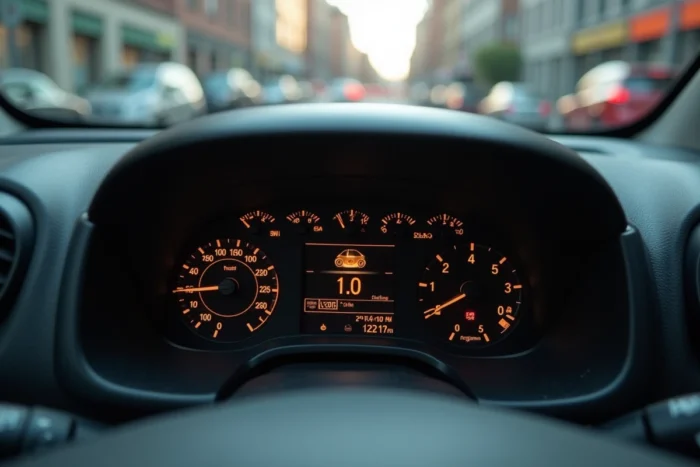
Orange engine light on Mercedes Vito: common causes and diagnosis
The engine light (check engine) is the most common and ambiguous. It signals any anomaly detected by the engine control unit, from a simple faulty boost pressure sensor to a more serious injection problem. An orange engine light never specifies the fault by itself: it is essential to read the fault code stored in the control unit.
On the Vito, recurring causes include the intake temperature sensor, clogged injectors (common on high-mileage diesel versions), and issues related to the particulate filter. The latter point mainly concerns vehicles used for urban delivery, where short trips prevent the passive regeneration of the filter.
Reading the fault code without going to the workshop
An OBD-II reader connected to the diagnostic port (located under the steering wheel on the driver’s side) allows for retrieving the stored fault code. Codes starting with P0 are generic and readable by most tools on the market. Codes starting with P1 or P2 are specific to Mercedes and require a compatible tool, such as the Star Diagnosis software or a high-end multi-brand reader.
Clearing a fault code without addressing the cause solves nothing. The light will return in the next engine cycle if the problem persists. However, a one-time fault code that does not reappear after clearing may indicate a loose connection or an intermittent malfunction.
ESP and ABS light: when the fault is software-related
The orange ESP light (triangle with circular arrows) or the ABS light indicates a fault in the stability control system. On the Vito, these two lights are often linked to the same control unit. The Kraftfahrt-Bundesamt (German Federal Motor Transport Authority) has documented recall campaigns regarding a software fault in the ESP control unit on Sprinter and Vito models produced until 2020.
In these specific cases, the light comes on without any actual mechanical fault. The correction involves reprogramming the control unit at a Mercedes dealership, without replacing any parts. This type of software fault is impossible to diagnose with a simple OBD reader, as the fault code points to the control unit without distinguishing a hardware failure from a software bug.
To find out if a Vito is affected by a recall, checking the VIN on the manufacturer’s portal or with an authorized workshop remains the reliable method.

AdBlue light and limp mode on recent diesel Vitos
The Vito W447 equipped with a Euro 6 diesel engine uses the SCR (Selective Catalytic Reduction) system with AdBlue injection. The associated orange light comes on in two distinct situations:
- The AdBlue level is low. The dedicated tank is usually located next to the fuel cap. A refill is enough to turn off the light after a few kilometers.
- The SCR system detects a malfunction (AdBlue quality sensor, injection pump, catalyst). In this case, the light remains on even after refilling, and the vehicle may switch to limp mode with power limitation.
- A third, rarer scenario concerns low-quality or contaminated AdBlue (accidentally mixed with fuel), which damages the SCR catalyst and generates a persistent fault code.
The limp mode related to AdBlue is progressive on recent Mercedes models. The dashboard first displays a warning message, then limits speed, and ultimately prevents any restart if the problem is not corrected. This behavior is mandated by anti-pollution regulations.
Reacting to an orange light: the correct sequence
The logic of response to an orange light on the Vito follows a precise order, regardless of the pictogram:
- Identify the exact symbol by comparing it to the manual corresponding to the vehicle generation (W638, W639, or W447), not to a generic guide.
- Check the levels accessible without tools: coolant, engine oil, AdBlue, tire pressure. A significant portion of orange lights turn off after correcting a low level.
- If the light persists, connect an OBD-II reader to retrieve the fault code before consulting a workshop, which avoids a blind diagnostic fee.
- Consult the manufacturer’s recall database with the VIN to rule out a known software fault covered by warranty.
A persistent orange light after checking the levels requires electronic diagnosis. Continuing to drive while ignoring the alert exposes one to entering limp mode, increased fuel consumption, or worsening an initially minor fault. The cost of a preventive diagnosis is always lower than that of a repair delayed too long.