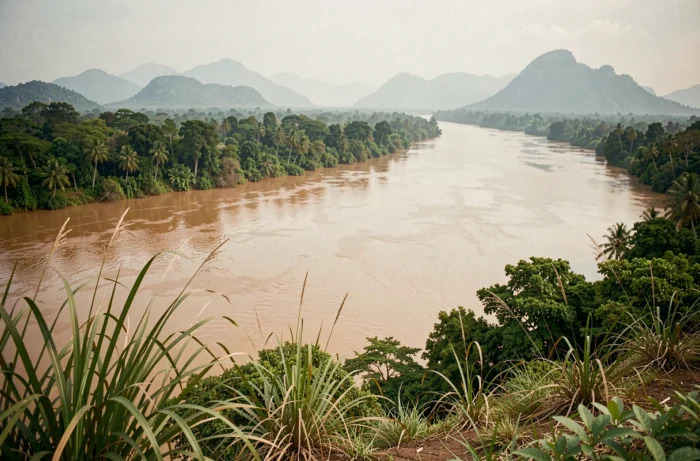
Rivers whose names start with the letter Q are never featured in major global rankings. However, they flow through regions where freshwater is vital for the survival of millions of people, from the Tibetan plateau to the arid plains of Balochistan. Listing the largest rivers beginning with Q requires looking beyond the usual rankings, towards less publicized waterways that face the same hydrological pressures as the Amazon or the Nile.
Qiantang, Qu’Appelle, Qarun: rivers on three continents
The Qiantang is the most well-known river starting with Q. It originates in the mountains of Zhejiang, China, and flows into the East China Sea after passing through the city of Hangzhou. Its uniqueness lies in its tidal bore, a wave that travels upstream, attracting large crowds each year.
The Qu’Appelle River in Canada flows through the prairies of Saskatchewan before joining the Assiniboine River system. Its flow remains modest compared to North American giants like the Mississippi, but it feeds several reservoir lakes used for agricultural irrigation in a semi-arid region. For more information, check out this comprehensive list on the largest rivers starting with Q.
In the Middle East, the Qarun (or Wadi al-Qarun) refers to a hydrographic system connected to Lake Qarun in the Fayoum, Egypt. It is not a river in the strict sense, but a watercourse historically linked to the Nile by a network of canals. Its case illustrates the difficulty of classifying certain waterways: river, stream, or canal, the distinction often depends on administrative as much as geographical criteria.

Flow and water resources: what recent data reveals
Rivers starting with Q share a common point with most global waterways: their flows are becoming more irregular from year to year. According to the WMO (World Meteorological Organization), in its State of Global Water Resources 2025 report published on September 17, 2026, rivers experienced one of their driest years in 35 years in 2025.
This trend is not limited to Amazonian or African basins. Watercourses fed by glacial or snowmelt, like the Qiantang whose tributaries depend on the monsoon regime, are experiencing amplified variations. Glaciers are no longer as effective in their role as seasonal reservoirs, altering the timing of floods and low water levels.
The specific case of rivers in arid zones
For the Qu’Appelle in Canada or the Qarun in Egypt, the question of flow arises differently. These waterways operate in contexts where evaporation and agricultural withdrawal weigh as heavily as climate change on the available volume.
Groundwater reserves are decreasing beyond just the riverbeds. The WMO report highlights that aquifers and underground reservoirs are also losing volume, reducing the natural recharge capacity of rivers during dry periods.
Hydrological monitoring of rivers starting with Q: persistent gaps
A famous river like the Amazon or the Yangtze benefits from dense measurement networks, with hydrometric stations spread over thousands of kilometers. Rivers starting with Q often find themselves in blind spots of global monitoring.
The WMO’s monitoring system relies on data from 52 countries and over 3,100 measurement stations, compared to just 7 countries and 14 stations during the first edition of the report. This progress remains uneven across regions.
- The Qiantang benefits from relatively comprehensive monitoring thanks to the Chinese hydrological network, but the data remains poorly accessible to the international scientific community.
- The Qu’Appelle is covered by the Canadian network of hydrometric stations, with long and publicly available data series.
- The Qarun, on the other hand, relies on Egyptian measurements whose frequency and transparency vary over time.
This disparity complicates any reliable comparison between basins. The available data does not allow for precise conclusions about the long-term evolution of the flow of some of these rivers.
Rivers starting with Q and geopolitical water issues
The water of rivers is never just a physical data point. The Qiantang supplies Hangzhou, a metropolis of several million inhabitants and one of China’s major economic hubs. Any change in its hydrological regime has repercussions on urban supply, industry, and agriculture in the delta.
The Qu’Appelle, for its part, flows through agricultural lands where irrigation directly depends on the level of reservoir lakes. Recurring drought episodes in the Canadian prairies raise questions about the sustainability of current uses.
The Qarun, a case study on historical water management
Lake Qarun, fed by canals derived from the Nile, has seen its salinity increase over the decades due to evaporation and reduced freshwater inputs. This phenomenon illustrates how a secondary watercourse can become an early indicator of regional water stress, long before major rivers show visible signs of decline.
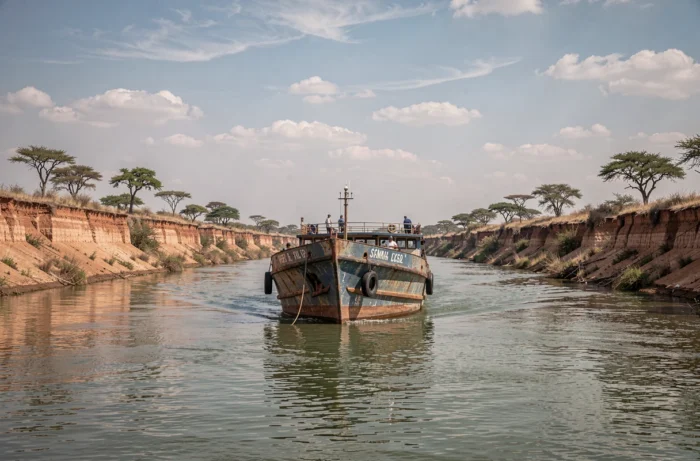
Rivers starting with Q remain discreet subjects of study in hydrological literature. Their modest size compared to continental giants does not protect them from global trends: increasing flow irregularity, declining groundwater reserves, uneven monitoring. Their monitoring would benefit from being integrated into international measurement networks, if only to refine the understanding of water cycles on a scale of less documented basins.