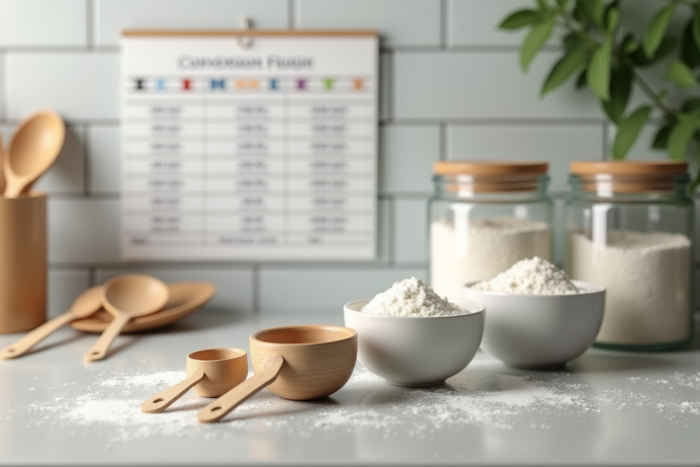
Navigating measurements and conversions in the kitchen can quickly become a headache. Between grams, ounces, cups, and milliliters, recipes sometimes seem to come from another world. However, mastering these conversions is essential for creating dishes that meet expectations.
Imagine preparing an American recipe that uses cups, while you only have a scale in grams. Or trying to halve a recipe without knowing how to adjust each ingredient. Understanding these subtleties allows for calm cooking, without unpleasant surprises.
The fundamentals of measurements and conversions in the kitchen
Cooking relies on a precise understanding of units of measurement. With recipes from various backgrounds, it’s important to know the equivalences between metric and imperial systems. For example, an American cup is approximately 240 ml, while an ounce represents 28 grams.
Common units of measurement
- Tablespoon: 15 ml
- Teaspoon: 5 ml
- Cup: 240 ml
- Litre: 1000 ml
- Ounce: 28 g
- Pound: 454 g
To convert milliliters to grams, one must consider the density of the ingredients. 200 ml converted to grams will depend on the nature of the ingredient. For example, 200 ml of water will weigh 200 g, but 200 ml of flour will weigh about 130 g.
Practical conversion table
| Ingredient | 1 cup in grams |
|---|---|
| Flour | 130 g |
| Sugar | 245 g |
| Butter | 240 g |
| Cocoa | 120 g |
Cooking also uses different units to measure quantities of liquids and solids. A tablespoon of milk will not weigh the same as a tablespoon of honey. Proper use of proportionality tables and understanding densities are therefore essential for accurate conversions.
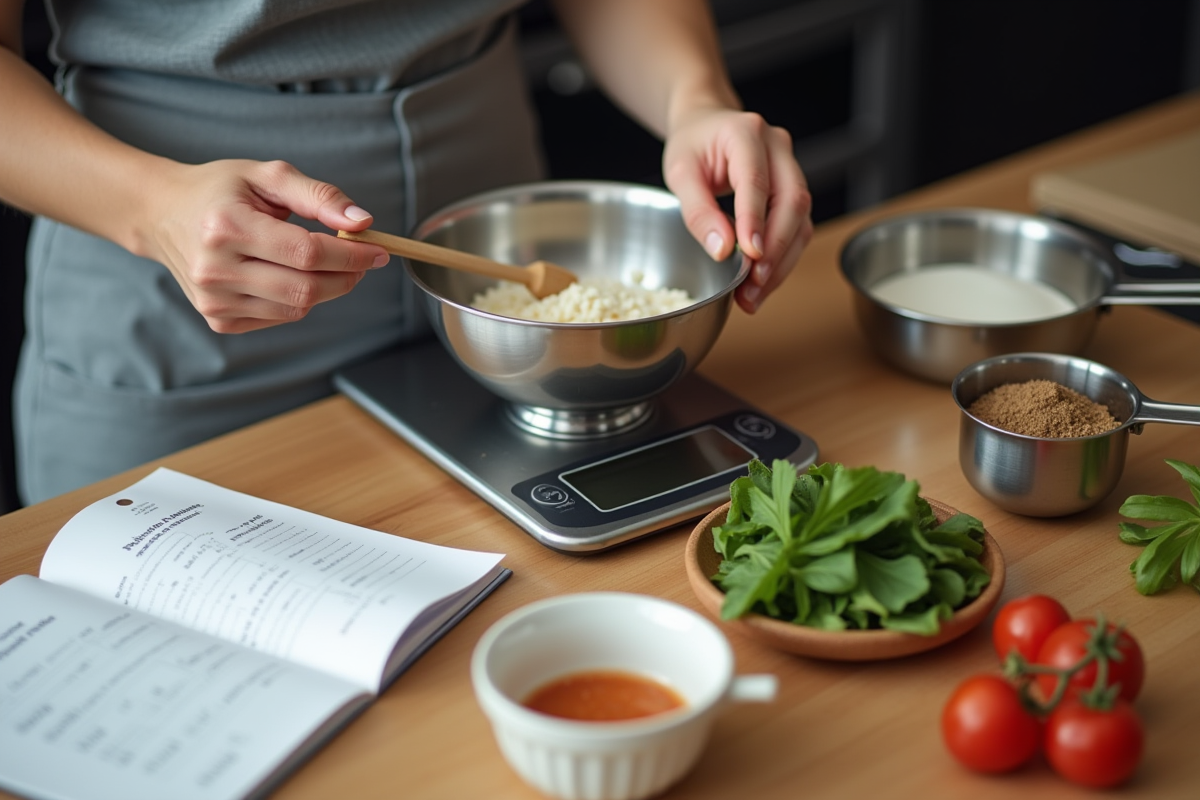
Practical examples and tips for successful conversions
Find the equivalences between units of measurement to avoid common mistakes. Here are some practical examples:
- 1 cup of flour equals 130 g
- 1 cup of sugar equals 245 g
- 1 cup of butter equals 240 g
- 1 cup of cocoa equals 120 g
- 1 egg equals 50 g
For a Margherita pizza recipe, follow these precise conversions. Take 2 cups of flour, which is 260 g, and add 1 cup of water, which is 240 ml. Add 1 tablespoon of dry yeast, which is 15 ml. Mix with a pinch of salt.
For the toppings, use 200 g of fresh tomatoes, 200 g of mozzarella, and a few basil leaves. Drizzle with a tablespoon of olive oil (15 ml).
Conversions are not limited to solid ingredients. For liquids, follow these equivalences: 1 liter equals 1000 ml, and 1 ml equals 0.034 fluid ounces.
Also, use practical tips for precise recipes. For example, a medium carrot weighs about 100 g, while a medium zucchini weighs between 200 and 250 g. A clove of garlic weighs about 6 g, a medium onion 100 g, and a medium potato 100 g.
For fruits, a tomato weighs between 100 and 200 g, a banana about 150 g, and an apple between 150 and 200 g. These equivalences make it easier to prepare international recipes without measurement errors.