
The intersection between the silver economy and ecological transition is not limited to installing a connected thermostat or sorting waste. It relies on precise technical trade-offs related to the energy performance of housing, the residual mobility of the individual, and the compatibility between public aid. We observe a persistent gap between the marketing promises of “green offers for seniors” and the reality of support pathways on the ground.
Energy audit coupled with housing adaptation: what MaPrimeAdapt’ changes
MaPrimeAdapt’, established in 2024 to finance the adaptation of housing for the elderly, provides for a connection with insulation or heating replacement work when these simultaneously improve thermal comfort and accessibility. This point is often overlooked by traditional home care providers.
In practice, a simplified audit can allow for the combination of replacing a bathtub with a walk-in shower and insulating the adjacent wall within the same funding application. Combining adaptation and renovation reduces project management costs and limits the duration of work, a critical factor for an elderly person living alone.
Structures offering this type of cross-support remain rare. Most Home Help and Support Services (SAAD) do not have internal expertise in energy renovation. We recommend checking if the provider works with an operator approved by the National Observatory of Energy Poverty or by the CLER network (Federation of Energy Transition Actors), two organizations that document these hybrid pathways.
To better understand how some actors structure this dual approach, you can learn more about Green Seniors, which references services combining daily comfort and energy sobriety.
Gentle mobility for seniors: often underestimated technical criteria
The electric-assisted bicycle (EAB) is often presented as the miracle solution for green mobility for retirees. The reality is more nuanced. The choice of EAB primarily depends on balance ability and grip strength, two parameters that deteriorate with age and that few retailers assess before the sale.
The most effective gentle mobility initiation programs integrate three components:
- A preliminary functional assessment conducted by an occupational therapist or physiotherapist, which identifies real contraindications (vestibular disorders, severe wrist osteoarthritis)
- A trial on an adapted course, with a low-step bike and a lowered center of gravity, not a standard model offered in stores
- A solidarity car-sharing or local public transport component for days when the EAB is not feasible (weather, fatigue, distant medical appointments)
Solidarity car-sharing among retired neighbors, documented in several local experiments, presents a double advantage: it reduces the number of parked thermal vehicles and maintains regular social ties. The key to success lies in the simplicity of the reservation system. A digital tool that is too complex excludes those who are less comfortable with technology.
Waste reduction and short circuits: where the real added value for seniors lies
Meal delivery from short circuits replaces two problems with a single solution: it eliminates trips to large stores (often cumbersome and energy-consuming) and reduces food over-packaging. Several platforms in the silver economy are beginning to reference local producers for their home meal delivery services.
Individual composting, on the other hand, poses practical difficulties that are rarely mentioned. Handling a compost bin requires the ability to bend down, turn the material, and transport the mature compost. For a person with partial loss of autonomy, collective composting at the foot of the building or in senior residences is more realistic than an individual bin at the back of the garden.
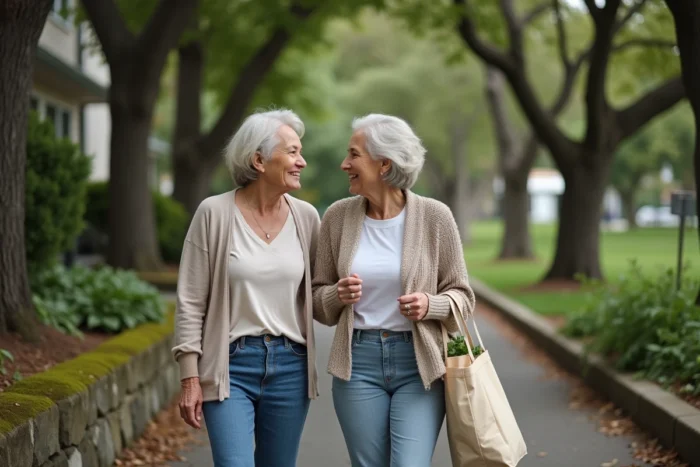
Workshops on waste reduction work better when coupled with an immediate financial benefit. A workshop that shows how to visibly reduce grocery bills by prioritizing bulk and local producers generates more lasting engagement than a discourse focused on carbon footprint.
Preventing energy poverty: a health as much as an ecological angle
Energy poverty affects a significant portion of retirees, especially those living in thermal sieves built before the first insulation regulations. The link between poorly insulated housing and health deterioration (respiratory infections, cold-related falls) is documented by the National Observatory of Energy Poverty.
Supporting a senior towards better-insulated housing produces a domino effect: lower energy bills, reduced episodes of winter illness, decreased avoidable hospitalizations. This triptych justifies that home support services integrate a “thermal diagnosis” component into their initial assessment, just like the evaluation of loss of autonomy.
Public aid exists, but their overlap (MaPrimeRénov’, MaPrimeAdapt’, local aid from pension funds) creates a discouraging administrative pathway. Providers that offer real added value are those who manage the file from start to finish, without the elderly person having to navigate between multiple offices.
- Check the cross-eligibility of MaPrimeAdapt’ and MaPrimeRénov’ before launching an adaptation project
- Require a single contact for the administrative and technical follow-up of the work
- Prioritize the insulation of living spaces (living room, bedroom) rather than a costly and lengthy overall renovation
The transition to a more sober daily life for seniors does not involve spectacular solutions. It relies on concrete trade-offs: coupling housing adaptation and thermal performance, choosing mobility compatible with actual capabilities, simplifying access to food short circuits. Providers who master these technical articulations, rather than offering generic catalogs, are those who produce measurable results in comfort and autonomy.