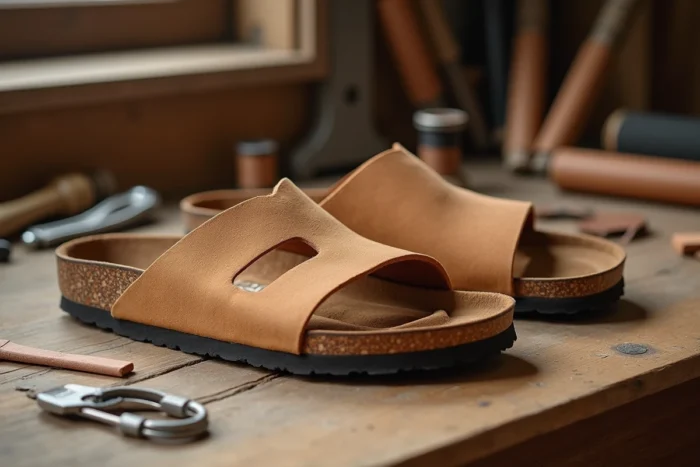
The price of a Birkenstock cannot be explained by leather alone. The sole, the footbed, the quality control in German factories, and the pricing power strategy post-IPO form a coherent whole that mainstream articles overlook. Here, we break down the technical and economic levers that set the price.
Footbed and technical sole: what distinguishes Birkenstock from a standard sandal
The centerpiece of a Birkenstock is the anatomical footbed made of cork and latex. This component is not a molded foam block like on most competing sandals. Natural cork, mixed with latex, is pressed and then sanded to fit the arch, metatarsus, and heel according to an anatomically developed template.
This design imposes tight tolerances. A deviation of a few millimeters in the curvature changes the foot support. The sanding is done by sizes and widths (narrow and regular), which multiplies the production references.
The outer sole made of EVA, often confused with basic rubber, is formulated to absorb shocks while resisting abrasion. We observe that this cork-latex-EVA combination ages better than conventional thermoplastic soles, extending the lifespan beyond several seasons of daily use.
When asking why Birkenstocks are expensive, the answer begins with this sole architecture that no one replicates identically in the mainstream sandal market.
Manufacturing in Germany and quality control: the real cost of European production
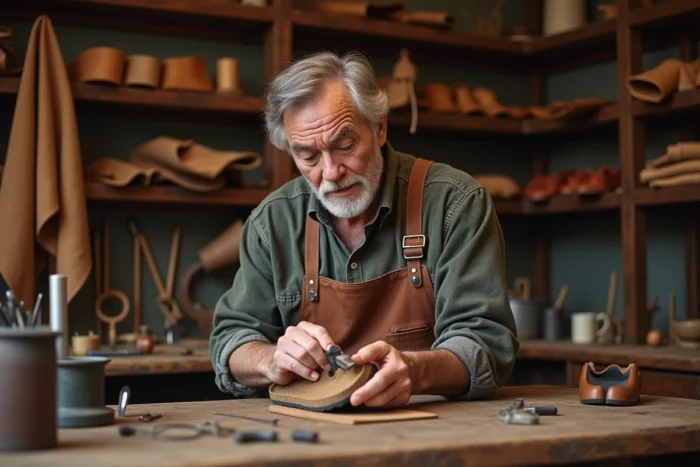
Birkenstock maintains almost all of its production in Germany, particularly in small industrial towns. This choice has a direct impact on the cost price.
- The hourly labor cost in Germany is among the highest in Europe, with no comparison possible to Asian workshops where the majority of market sandals are assembled.
- Quality control occurs at several stages of assembly: checking the bonding, visual inspection of the leather, testing the flexibility of the sole. Each defective batch is discarded, resulting in a rejection rate higher than that of less demanding outsourced production.
- The raw materials (leather, cork, jute for the midsole) are selected according to strict specifications. The leather used for the straps comes from European tanneries, with a considerable annual volume of processed bovine hides.
Producing in Germany is significantly more expensive than in Southeast Asia, but guarantees complete traceability of the supply chain. This differential is directly reflected in the retail price.
The role of jute and cork in the structure
Between the EVA sole and the cork footbed is a layer of jute. This natural textile provides structural rigidity to the sandal and partially regulates moisture. Without this layer, the cork would deform more quickly under repeated stress. Textile-quality jute, tightly woven, is more expensive than the synthetic reinforcements used by competitors.
Pricing power and premium repositioning after the IPO
Since its IPO in 2023, Birkenstock has been analyzed by financial markets as a brand with superior pricing power compared to the average in the footwear sector. This term refers to the ability to maintain or even increase prices without losing sales volume.
This power relies on several mechanisms. Demand remains strong despite successive price increases. Collaborations with luxury brands (the most expensive co-branded model reaches several hundred euros) anchor the brand in a premium universe. Selective distribution limits points of sale and reduces promotional pressure.
We observe a strategic shift: Birkenstock no longer positions itself as a manufacturer of orthopedic sandals but as an established fashion brand. This sustainable premium repositioning justifies prices above the actual production cost. The gross margin finances R&D on materials, targeted marketing, and international expansion.

Perceived rarity and limited editions
Limited editions and collaborations create a sense of rarity that fuels desirability. A classic Arizona model and a co-branded version with a luxury brand share the same technical base, but the price can double or triple on the limited version.
This strategy is not unique to Birkenstock. It borrows from the codes of sneaker collecting, where perceived rarity exceeds the intrinsic value of the product. The difference is that the technical base of Birkenstock remains the same regardless of the collaboration, which maintains a quality floor absent in some competitors who offer low-end models in special editions.
Price differences between European and North American markets
The same Birkenstock model can cost significantly more in North America than in France. This gap, which can reach half the European price in additional costs, is explained by customs duties, transatlantic logistics fees, and the pricing strategy chosen for the American market.
France is among the top three global markets for the brand. This geographical proximity to the German factories reduces transportation costs and allows for more contained prices than across the Atlantic. Therefore, for a purchase in Europe, the quality-price ratio remains more favorable than in the United States.
The inflation of raw materials since 2021 has also pushed prices up across all markets. Leather, cork, and EVA resins have seen cost increases that Birkenstock has passed on, unlike some fast fashion brands that absorbed the rise by reducing the quality of components.
The price of a Birkenstock reflects a trade-off between demanding European manufacturing, durable technical materials, and a premium brand strategy. Comparing this price to that of a sandal assembled in Asia with a generic foam sole is like comparing two products that do not meet the same specifications. The cost is justified by the longevity and technicality of the footbed, not just by the prestige of the logo.